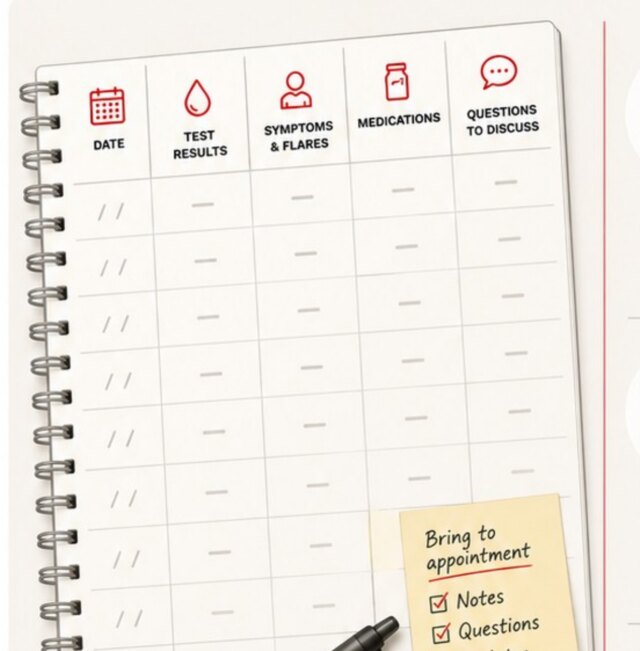
Tracking helps you bring useful information into your appointments. Keeping notes in one place can help you and your healthcare professional see patterns and make more informed decisions together over time.
01
Know your numbers
Keep important test results and markers in one place to review together.
02
Symptom & flare notes
Track how you feel, any changes, and possible triggers over time.
03
Medication & appointment notes
List your medicines, appointments, and questions to discuss.
Keeping notes in one place helps you and your care team see patterns over time.
"What you write down today can shape a clearer conversation tomorrow."
Tip: the downloadable guide includes printable trackers you can fill in and bring with you.
01 · Track
Know your numbers
Tracking important test results and markers over time can help you and your healthcare professional see changes that matter. For each result, it helps to record:
A simple tracker keeps your results, symptoms, medicines and questions in one place.
Test / marker
For example CRP, faecal calprotectin, or other tests you've had.
Date
When the test was taken, so you can see changes over time.
Result
The value as recorded by your care team.
What I want to ask
Any questions you'd like to raise about the result.
Ask what each result may mean
Together you can look at the bigger picture across time — not just one number.
Notes for my next appointment
What would I like to understand better?
02 · Track
Symptom and flare notes
Notes about how you feel, any changes, and possible context can help you and your healthcare professional see patterns worth discussing. For each entry, it helps to capture:
When & what changed
The date, and what symptoms or changes you noticed.
How often
How frequently it happened.
Possible trigger or context
What was happening around that time.
Impact on your day
Work/school, family, sleep, travel, mood, or appetite.
Patterns over time may be useful
Bring your notes to appointments so your healthcare professional can review the bigger picture with you.
Questions to ask
Note anything you'd like to discuss at your next visit.
03 · Track
Medication and appointment notes
Being prepared helps you and your healthcare professional make the most of your time together. Keep your medicine information, appointments, and questions in one place.
Medicines I take
Including prescription medicines, over-the-counter products, and supplements — and how you take each.
Changes since my last visit
New or stopped medicines, dose changes, new symptoms, or health and life events.
Upcoming appointments
Dates, times, and purpose — plus any tests or scans that are scheduled.
Questions I want to ask
Write down questions in advance, and prioritise those that matter most to you.
Bring this to your next appointment
It can help you and your healthcare professional stay organised and focused on what matters most.
Even small changes matter
Sharing small changes can be important to your care.
This guide is for educational purposes only and does not replace medical advice. Always talk with your healthcare professional about your condition and treatment.